Precision low-impact mulching creates drivable access and better habitat for deer, turkey, quail, and pheasant across Kansas, Missouri, Nebraska, and western Iowa — while enabling targeted biological support for lower tick pressure on both game and hunters.
All work originates from our Leavenworth County, KS base. Remote pre-qualification available for regional projects.
Overgrown understory makes access frustrating — hard to get stands, cameras, gear, or haul game out cleanly and with minimal damage to the land.
Thick edges and cover that hold game also concentrate ticks. This creates parasite pressure on deer, turkey, quail, and pheasant (impacting condition, fawn/poult survival, and antler quality) and turns hunts into a battle with ticks for people and dogs.
Traditional heavy clearing or blanket mowing to “dry out” ticks often destroys the very thickets, edges, and interspersion that wildlife biologists recommend for strong populations. You lose the habitat to gain marginal tick relief.
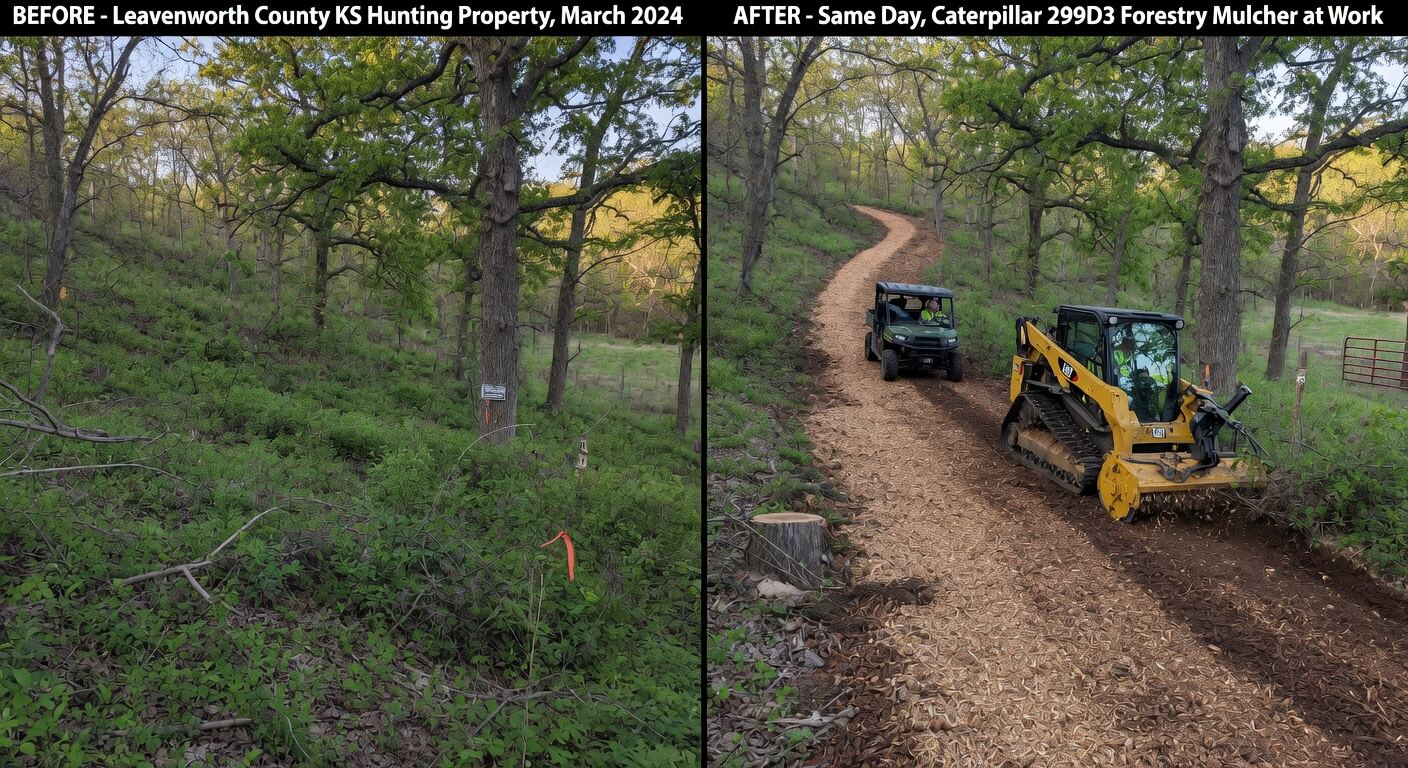
Precision forestry mulching opens clean, drivable trails and productive edges while preserving — and actively enhancing — core cover and thickets that game species need.
We layer in proven habitat features built from on-site material: covey headquarters, edge feathering, hinge-cut bedding thickets, and food plots positioned correctly next to escape cover. Trails become the practical backbone for targeted biological tick controls (entomopathogenic fungi such as Metarhizium and Beauveria, and nematodes such as Steinernema blends) applied precisely where hunters and game overlap most — without landscape-wide disturbance that harms the cover wildlife requires.
Regional note: We travel from our Leavenworth base for qualified hunting land projects across the expanded footprint (Kansas statewide, western and central Missouri, eastern and central Nebraska, and western Iowa). Larger or multi-feature packages are the best fit for regional mobilization.
Targeted, habitat-friendly tools that work with — not against — good game cover.
Many conventional tick treatments rely on broad sprays or heavy clearing that can harm the very thickets and edges deer, turkey, quail, and pheasant need. Our approach uses nature’s own microscopic allies — beneficial fungi and nematodes — applied precisely where they’re most effective, thanks to the access trails we create.
Traditional blanket clearing to reduce ticks often removes the escape cover, nesting thickets, and edge habitat that drive game populations. Our mulched trails create linear access for precise applications while we actively enhance the surrounding habitat features game needs. The disturbed soil and mulch layer from mulching can even create favorable micro-sites for these beneficial organisms.
Biological controls (especially the fungi) show real scientific promise for reducing tick numbers and disease risk in treated zones. However, they are not a silver bullet.
Local conditions (moisture, temperature, tick species) matter. We align recommendations with current guidance from university extensions in each state we serve. Many clients see the biggest improvements when biological support is paired with the habitat work itself.
These tools are suitable across our service area, with application timing guided by local conditions in Kansas, Missouri, Nebraska, and western Iowa. Ask about our landowner one-pager on biological tick controls and habitat practices.
Species-specific practices that support real population responses across our regional footprint.
Core principle: Interspersion and quality edge beat any single feature. Populations respond best when food, cover (escape, thermal, nesting/brooding, roosting), and water are close together in a mosaic. All practices drawn from Pheasants Forever / Quail Forever, KDWPT, Missouri Department of Conservation, Nebraska Game & Parks, Iowa DNR, and university extension guidance across the region.
Honest framing: Biological controls show strong promise in studies (e.g., 50%+ nymph reductions for certain EPF applications) but work best as part of an integrated approach (personal protection, host management, habitat). Not a silver bullet or one-time fix. Regional tick species vary (lone star dominant in KS/MO; blacklegged more relevant northward); we align with local extension guidance.
Every hunting land project starts with a free 15-minute on-site assessment (or remote pre-qualification via photos, drone/video, property maps, and goals discussion for distant regional projects). We evaluate access needs, existing habitat quality, tick pressure zones, and your goals, then design the right combination of trails + features.
Selective mulching for clean, durable Ranger/UTV trails and productive edges. Option to leave beneficial mulch in place for soil/habitat benefit or haul selected zones for cleaner access.
Brush-pile covey headquarters, edge feathering/soft transitions, hinge-cut bedding thickets, food plot prep (with correct adjacency to cover), mast tree release, and invasive control that helps game.
Identification and light prep of strategic buffers (trail edges, stand perimeters, plot buffers) for client or partnered precision application of fungi/nematodes. Trails are the key enabler for low-impact, targeted work.
Drainage for productive plots, storm recovery on hunting land, power washing blinds/structures, and recurring edge/trail mowing maintenance packages that keep access open and promote forbs.
This specialized hunting trails and habitat service operates on an expanded regional basis (distinct from the standard 35-mile radius used for general forestry mulching, tree services, storm work, and most other Trail Cutter services).
Leavenworth County KS and surrounding counties (Wyandotte, Platte, much of Johnson County KS, portions of Clay County MO including Liberty). Many projects here are straightforward same-day or short multi-day work.
Base of Operations: All work originates from Leavenworth County, KS. Our mulching equipment is transported as needed.
Qualification for Distant Jobs: Minimum project size/economic threshold applies. Remote pre-qualification (photos, drone/video walkthrough, property maps, goals discussion) is strongly encouraged before committing to long-distance mobilization. Larger or multi-day hunting habitat packages are preferred for regional travel.
We bring the same trusted equipment and biology-aligned approach to qualified hunting properties throughout the region.
Before/after progression photos, Ranger/UTV access shots, haul-out and shooting lane examples from actual work. We prioritize authentic rural acreage results over staged photography.
Species practices and biological control details drawn directly from university extensions, state wildlife agencies (KDWPT, MDC, Nebraska Game & Parks, Iowa DNR), Pheasants Forever / Quail Forever, and peer-reviewed/field studies on entomopathogenic fungi and nematodes. Honest limitations included.
Legacy from Superior Lawn & Snow + professional heavy equipment capability. One team for initial habitat work plus long-term care (mowing, drainage, storm recovery, power washing). Strong cross-promotion with our other Trail Cutter services. Free 15-minute assessment process sets clear expectations.
Mulched trails with proper width and feathered edges naturally resist rapid brush regrowth better than simply cut paths. Expect 3–5+ years before significant re-work in many cases, depending on soil, species, and rainfall. Annual or biannual light mowing of edges and trail shoulders (available as a bundle) keeps them clean and promotes beneficial forbs.
When implemented with proper interspersion, covey headquarters, feathered edges, and plots next to cover, populations respond. Results are not instantaneous — habitat improvements compound over seasons as cover thickens, food sources establish, and birds/deer learn the new structure. We follow proven practices from state agencies and Pheasants Forever/Quail Forever biologists.
See the full educational section above for detailed evidence, limitations, and why trails are the key enabler. Field results show meaningful reductions in treated zones when used as part of an integrated strategy. Not eradication, and not a substitute for personal protection or good habitat design.
Detailed explanation and honest limitations are in the Biological Tick Reduction educational block directly after the Approach section. Fungi use spores that penetrate and kill from inside; nematodes parasitize engorged females in the soil/litter. Both are applied precisely thanks to the trails.
These are targeted, naturally derived organisms with low non-target impact when used as directed (precision zones only, not broadcast across thick cover). They are compatible with game habitat goals. We still recommend standard personal protection and tick checks for hunters and dogs.
Biologicals are weather- and season-dependent. Spring and fall windows are often optimal. Re-application is typically part of an ongoing integrated program rather than a single event. Trails give easy repeat access. We provide guidance aligned with local extension timing for your specific county and state.
We walk (or review remotely) the property with you, discuss hunting use and goals (more birds? better deer movement? easier access and recovery? tick concerns for hunters/dogs?), identify high-value zones for trails and habitat features, flag opportunities for covey HQs, feathering, plots, and biological prep areas, and give clear next-step recommendations and a written quote. No pressure.
Light periodic mowing of trail shoulders and edges keeps access clean and encourages forbs. Some re-mulching or feathering touch-ups every 3–5 years depending on growth. We offer maintenance bundles. Sanctuary thick cover areas are left largely undisturbed.
Yes — the core principles (interspersion, edge feathering, covey HQs, trails as access for precision work) translate well. Pheasant emphasis is stronger in central/western KS, NE, and western IA; quail and transition-zone species are strongest in eastern KS/western MO. Tick species and optimal application windows vary slightly; we adapt recommendations using local extension resources.
More questions about your specific property or regional conditions? The free assessment is the best next step — it’s educational by design.
Start with a free 15-minute assessment (on-site or remote pre-qual for regional projects). We’ll evaluate your property, discuss goals for more game and better hunts, and outline the right combination of trails, habitat features, and biological support options — with clear expectations for regional travel when applicable.
Schedule Your Free 15-Minute Hunting Property AssessmentLeavenworth base • Regional travel for qualified hunting projects • No obligation